Introduction
For more than a decade, our online digital world has been stagnant: the same tabs, apps, and routines, humans laboriously searching by hand, filtering, reading, going too fast, making mistakes, taking wrong turns, filling out forms, and waiting for humans to reply by email. Now we are finally emerging from that chrysalis of low economic growth, low human productivity, and slow innovation. What emerges is the agentic economy — an economy powered by intelligence and agents able to not just do repetitive work at scale but to execute judgment at scale — accelerating economic growth in ways that we can’t fully see from here.
This is a one-time transition from the person-to-person world of the past to the machine-to-machine world of the near future. By 2050, buying things by searching, viewing, pointing, and clicking will be a distant memory. There will still be some people who enjoy retail shopping, of course, and there will be scams and bad actors using machines to con or steal money. But the infrastructure we use to do business every day is not going to play much of a role in the rest of this century. From then on, it will all be machine-to-machine.
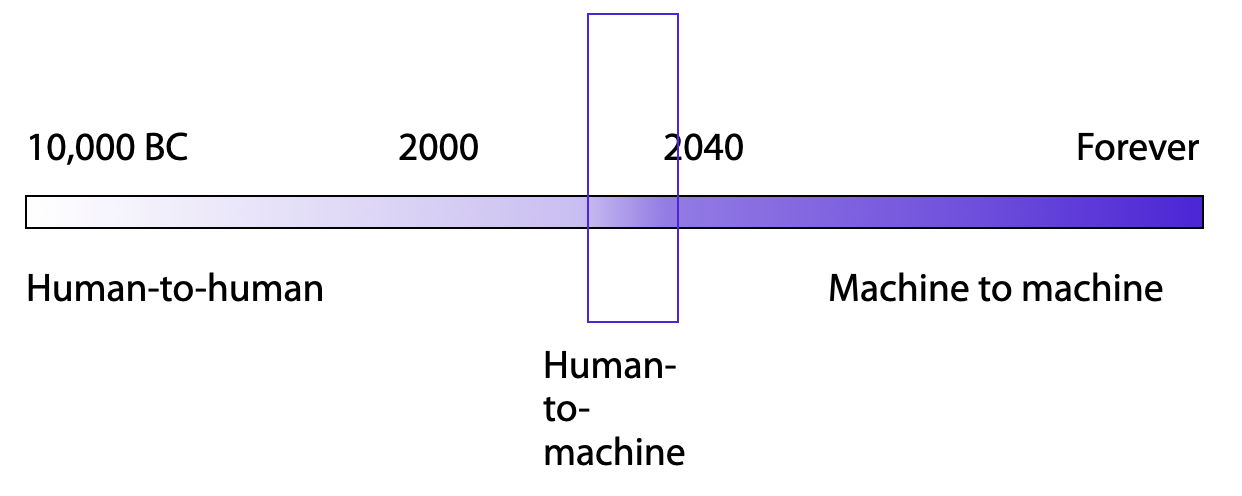
We already see this in the stock market. On the New York Stock Exchange, at least 70 percent of all trades are done by machines, and about 25 percent of all trades are held for less than one second. Did you get that? The exchanges already run mostly headless and lights-out, with humans on both ends. The humans don't enter the trades they want to make. Instead, they run general algorithms and let the algorithms make all the decisions for which stocks to buy and sell and when and how. All of this runs headless and lights-out, without humans driving. They make adjustments to the algorithm, and they watch the results come out the other end. The market action is a black box.
In 2036, just ten short years from now, humans manage the two ends, where we say what we want, the process happens by itself, and we get results and give feedback. Autonomous intelligence runs everything in between, at machine speed and machine scale, stripped of everything that existed only to serve a human in the loop.

In the same way that the stock exchanges have all had to retool their infrastructure to handle high-speed trading, all our digital infrastructure will need to be reimagined to empower the machines that will do most of our work for us. Right now, we’re in a very awkward phase, where machines have to work alongside humans. By 2036, that balance will tip in favor of machines, so we’ll start to work in territory that is natively built for machines and that humans only get a glimpse of as needed.
Let's start with a story.
The road to Aspen
The year is 2036. The car that picks us up has no steering wheel. You tell it where we're going in English: "Take us up to the place in Aspen, and find somewhere good for lunch in Glenwood Springs." It pulls out and merges into traffic that runs faster and tighter than it did back in 2026, because human drivers are no longer allowed on the road. A human behind the wheel, even if she’s concentrating, is far less safe than letting the cars coordinate with each other a thousand times every second.
You started this trip by talking with your car in English, though you didn’t have to say much. And you'll finish it in English, standing in a driveway, unloading your luggage. In 2036, humans interact with machines mostly in the first and last mile. The middle miles run headless and lights-out.
Headless means no controls and no feedback: nothing a human would need to drive a car, fly a plane, or run software. You don’t need to plug in and operate the machine, you can let it run on its own. While most jumbo jets today can land themselves in pretty much any weather, many pilots prefer to land the plane simply because it keeps them in practice in case they actually need to take over. In most cases, that brief phase will pass, and we’ll hand all the responsibility to machines without watching. A headless airplane will have no pilots (we can do that today, but passengers aren’t ready for it).
Lights-out means no lights and no creature comforts, because no creatures need to drive. The process is a black box. A few factories are operating lights-out today. Soon, many processes will operate lights-out. There won’t be any need to watch the machines doing the work — the human just needs to check the output and say whether it’s acceptable or not. In multi-step processes like making cars, the machines will double check everything until a finished car comes off the line. In some areas, humans will be required to remain in the loop, but more and more studies will show that the humans cause more problems than they catch.
A bowl of chili
You arrive at the condo in Aspen hungry, and you want to make a fresh pot of chili for dinner, but that’s going to require opening several cans of beans, tomatoes, and other ingredients. Sadly, your ancient can opener has rusted shut.
Back in 2026, you would have gone to Amazon and looked at fifteen can openers before picking one at random off the star ratings, knowing half the ratings and reviews were spam. Then you'd wait a few days and you’d be able to make your chili.
In 2036, you don't ask for a can opener. You ask for a bowl of chili. Your agent knows you. It knows what's in the fridge and the cupboard. It knows you love to cook, that you have time this evening, and that the can opener died a long time ago. It knows the neighbor down the hall is a friend, so it asks her agent whether she has a can opener to lend, learns that she's home, and two minutes later she knocks on the door and you open the beans while you have a nice chat over a cup of tea. Meanwhile, your agent orders a new can opener and everything you'll need for the next pot, and it all arrives in a few days.
Notice what you never did. You never searched. You never compared. You never filled out a form. You never opened a website, you never clicked, and you never downloaded an app. Your agent read your mind and took action on its own.
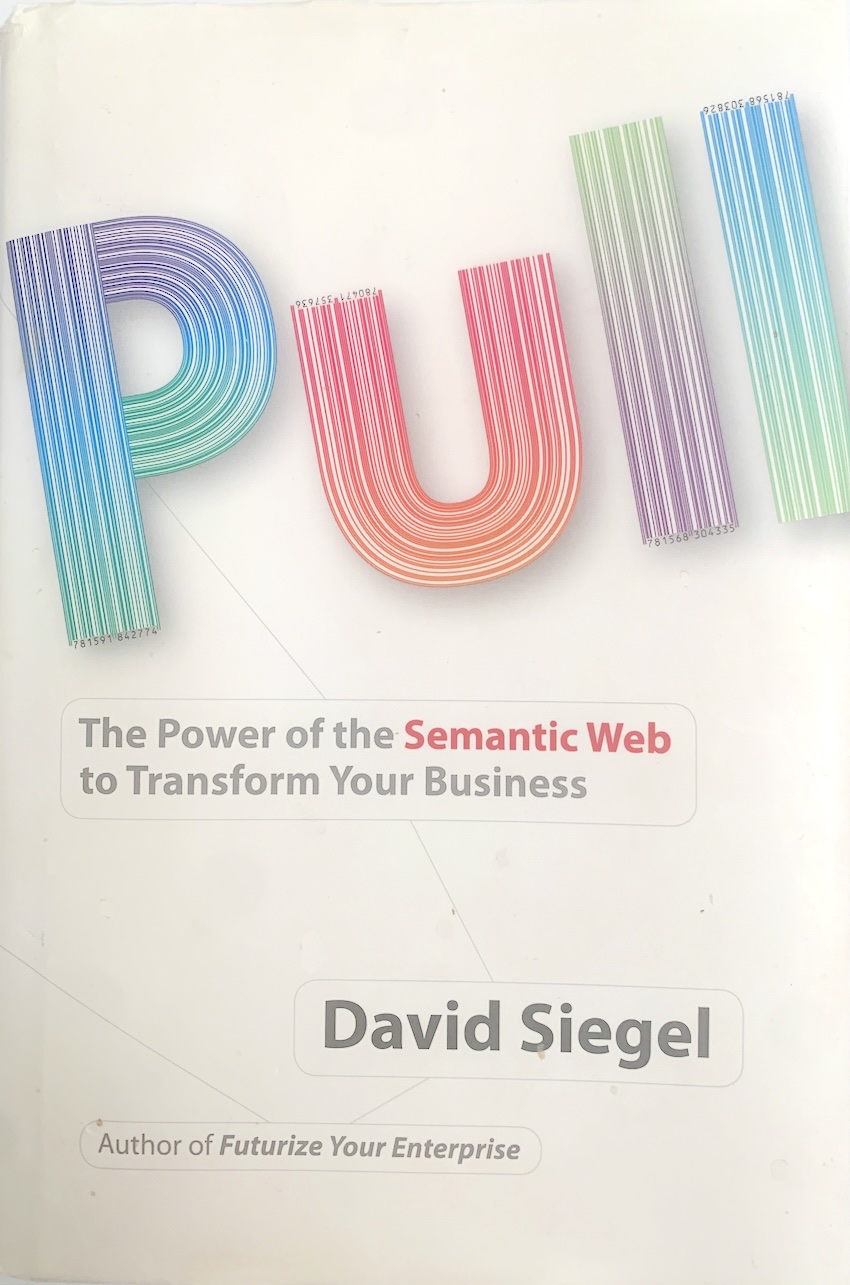
Back here in 2026, we’re finally entering the era I described in my book, Pull, from 2010. You can buy it on Amazon today, and I highly recommend the hardcover version for the best reading experience, though I understand many people would prefer the Kindle version.
We’re doing it differently than I envisioned, but the goal is still the same: give customers the ability to pull products and services, focus on the outcome, and streamline the intermediary processes. Markets are conversations, not linear processes, which is why we need agents, not software. The goals keep changing and the system keeps adapting as society moves forward.
1. The architecture of pull
To start, I want to explain what a mesh network is. A mesh network is a semi-structured network that adapts to the needs of its users. When you send an email message, you’re sending it into a system that automatically routes it to the destination according to where there is less traffic. The message could even be broken into parts and reassembled by the receiving server. No matter what happens to the network, the message finds its way. It isn’t planned in advance — the message moves from one server to the next, always getting closer to its destination without following a map or a planned route.
StarLink
This is exactly how Elon Musk should have built StarLink — as a mesh network, rather than a proprietary company. StarLink currently has almost 11,000 satellites in low-earth orbit. Any company that wants to compete with StarLink must set up its own fleet of thousands of satellites to reinvent the network, which puts much more material in space and does not result in more overall profit for the industry. As a mesh, StarLink would be a protocol and SpaceX an enabler. Companies would be able to launch their own satellites into the array and they immediately start cooperating, routing packets. Musk knows about mesh networks. He chose proprietary over open, but that is not the future.
Other mesh networks include the web itself, GSM, shipping containers, Tor, many electrical grids, bitcoin, and more.
Pulling packages
Today, most packages flow via the main carrier networks: UPS, FedEx, USPS. In my book, I explain how a mesh network could move packages differently. You could just write the unique name ID of the person you’re sending to (it could be a QR code), drop it in a mailbox or with any driver, and the package can make its way to its destination by finding its own optimal route, taking into account schedules, costs, weather, traffic, special offers, insurance, and more. In fact, the recipient can pull the package to her, so even if she’s traveling it will get to her hotel, and she’ll receive a message to pick it up or have it delivered to her room.
Instead, we have proprietary networks, where each one has to provide the first and last mile, even though some are much better at the first/last mile in rural areas, others can deliver by drone, some are better at long-haul, air freight, etc. They rarely work together, because shipping is not a mesh network.
2. Sensemaking
Palantir helps enterprises collect all the data in all their databases and make sense of it. Now, in 2026, we're starting to see "The Palantirization of Everything." Every day I hear about another company that says "We're the Palantir of ..." and names a vertical industry. This will revolutionize decision-making in companies, which can employ agents to make sense of their world and take action on their own.
The "Palantirization" of enterprise architecture describes the inevitable rise of an abstraction layer that connects the raw organizational data to autonomous AI agents. As companies transition from passive chat interfaces to active agentic workflows, the primary bottleneck is no longer model intelligence but operational sensemaking.
Guess vs know
There are two main ways to make sense of the digital world. The first is to guess. The second is to know.
Google mostly guesses what everything on the web means, though not entirely. To understand how to read an annual report, Google’s algorithm reads tens of thousands of annual reports. Over time, it sees patterns and starts to figure out what’s going on. This is machine learning. At some point, it can read an annual report and answer questions about it. It can do the same for all camera models, all drugs, laws, sporting events, etc. This is what Google does particularly well: making sense of large amounts of mostly unstructured data.
Show Google a photo of you and your friends on a hike. The more photos it has seen of you and your friends, the better it gets at figuring out who’s in the photo. Something like this is happening in China now, where ubiquitous surveillance cameras help Chinese authorities track 1.4 billion people using millions of cameras in public places all over the country. To do it with any degree of accuracy, the algorithm needs billions of photos and a sensemaking database that learns the differences, so it can tell faces apart. This isn’t programmed. We don’t know how the algorithm actually works; we just know that with enough data it can tell faces apart.
There’s another way to do it, though. If every person in the photo is carrying a digital tag, then the camera could sense those tags and accurately put the identities together with the faces in the photo, and that data can be part of the photo. Each person who wants to be identified can turn on his/her tracker chip and the camera can collect the data. Those who don’t want to be identified can turn their chips off.
This approach doesn’t require much data at all, and it’s done with permission. This is what I call a semantic approach, rather than a statistical approach. The semantic system almost never has a false positive or negative, and in many cases people want to be identified, so everyone has an incentive to make the system work.
It’s also a pull system. When a group of people all take a trip, they can keep their chips turned on the whole time. When they get home, everyone uploads his photos, and each person can easily find the images he’s in. By encrypting this information, it can be available only by permission, people control who can see/use it, and the cameras do the work easily. This is much easier than everyone sharing all the photos and people or software having to look through everything to tag themselves.
So in fact we have three ways to recognize faces:
- Machine learning, which requires a lot of data, training, and guessing. Can be wrong. Can be invasive.
- Those who know the people can recognize them.
- People can make their identities known as they desire.
This is sensemaking - turning data into useful information in context. We’ll see it in action many times in the following stories. When combined with a pull strategy, everything changes.
The living ontology
Google has an internal database that makes sense of the world, but other companies don’t get to use it. Palantir built something similar, and they license it to their customers. The sensemaking layer provides context for data. It comes between a company’s data and its users - which can be humans, software, or agents. In Pull, 16 years ago, I profiled dozens of companies that provide ontologies and other sensemaking tools to help software make real-time decisions. Today, this category of software is exploding, and it’s very specifically aimed at each vertical, each job, each situation. A single robot will use different ontologies for driving a dump truck, performing open-heart surgery, or babysitting.
An ontology is a map of meaning. An ontology can:
- take a scene of pixels from a car’s front-facing camera and recognize that it’s the entrance to a hospital
- determine whether a person coming toward us is a friend or an enemy
- watch thousands of cameras at an event and look for any unusual behavior
- watch a production line and see what needs attention
- predict which player is most likely to score next
Context is the big missing layer for many problems right now. You can think of it like counting cards in blackjack - whoever knows which cards have already passed has an unfair advantage against the rest.
Here’s an example that may help: you order shoes online, but you often need to order 2-3 pairs to get a pair you like. You can tell the styles visually, but you can’t tell how they fit or feel. That’s because we don’t have an ontology mapping shoes to feet. You could imagine a company that asks all shoe companies to send ten pairs of shoes in different sizes for each style each shoe company makes, and it has an army of scanned and tested feet that try the shoes and give feedback. With enough data, the company can construct an ontology of what works for whom. You’d be able to choose shoes by choosing the kind of feet yours are most similar to, you’d avoid ordering shoes that aren’t going to be comfortable, and you’d get a perfect fit and performance for those you do order. Given the number of returned shoes each year, I’d think someone would be working on this.
An ontology also captures relationships, hierarchies, and dependencies. A dataset may not tell you how the items are related. In a photo, you may not know who are the parents and who are the children. In a text, you may not know the relationships between the images and the concepts, the people and the company, or the scalability of a recipe. Again, we can infer these, or we can get this data explicitly from the source.
Machine languages
Standardized interfaces allow agents to interact with legacy software, APIs, and internal systems through a controlled, machine-readable language. But APIs are just part of the story.
MCP servers interact with systems using APIs, system logic, and English language. You can just type English to an MCP server, and it will do things for you, like buy a plane ticket, reserve a hotel room, run a marketing campaign, etc. You can even use an MCP server to find humans you can pay to do things for you in the physical world. But having machines talk with each other in English I think is silly. There are many reasons not to do that. They can do better talking in a kind of machine shorthand, like JSON or other specialized languages, plus data.
I predict these machine languages will emerge. To a small degree, they already have. But we’ll want to support them, formalize them, and make them as useful as possible, to help our helpers work in the dark on our behalf.
On the other hand, there’s a very real chance that systems working in the dark will find ways to collude, hide information, lie, and otherwise conspire, exactly where we’re not looking. Believe it or not, I’m not too worried about this, because we can also use other AI systems to watch them and make sure they can’t do anything we don’t want. These are sentries, and they will be important parts of the headless ecosystem. It may be an arms race, but I don’t predict it will end catastrophically.
3. World data
Cars are getting pretty good at understanding the world they live in, because we now have billions of recorded driving miles. But for everything else, we need much more data than we have now. The military and professional sports teams have a lot of the data they need, and they will keep getting more sophisticated in their needs. For example, all Formula-1 tracks have now been mapped and modeled with one-centimeter precision, so the cars can not just feel and adjust to the track as they drive but anticipate what’s coming next.
We need data-driven models of cities, factories, houses, neighborhoods, roads, infrastructure, and landscape. A company called Blackshark makes a high-resolution digital twin of earth. Every day they digitize 7 million square kilometers of earth and add it to their model, which keeps getting better and better all the time.
Ultimately, we’ll need data to model the physical world down to 1 cubic centimeter, including all the floors and hallways in all the buildings, so people in wheelchairs and autonomous vehicles can plan and execute their routes through real spaces. We’ll also need accurate real-time wind maps, cloud maps, traffic maps, and even data on skyscrapers, cranes, construction equipment, and drones moving through the skies. We have the beginning of many of those systems now; they will become critical data providers within a few years. Everything that’s “smart” will need much more real-time data than we have today.
We’ll also use 3D worlds that are not based on reality. We’ll use synthetic (made-up) worlds for training robots, games, and entertainment. While visiting these worlds, we will also use intelligent agents to do things for and alongside us.
NVIDIA is developing physically accurate 3D environments to accelerate robot training. Omniverse serves as the core platform for building real-time digital twins of industrial spaces like factories and warehouses. Within this framework, Isaac Sim acts as a virtual physics sandbox where autonomous machines safely test sensors and practice navigation. Cosmos enhances this process by using generative world foundation models to predict complex physics and generate infinite synthetic video data, allowing robots to master real-world scenarios entirely in simulation before hardware deployment.
Video has become the default training data. Waymo pioneered the use of LiDAR to navigate with 3-D data, but Elon Musk has insisted on using video, because video cameras are much cheaper than LiDAR systems, and because video works well when your car or robot has seen enough video. Figure’s robots have extra cameras in their hands to provide better signal and feedback.
Robots take video signals and turn them into action instructions. They are learning a lot from how-to videos and also from game videos. Now they will train on videos made by other AIs that can create millions of situations where robots interact with the physical world. We’re going to need billions of such videos to train robots.
The more realistic the video, the better. One company is now cleaning apartments in New York for free, in exchange for the data they collect while doing it. We’ll need data for plumbing, electrical work, construction, manufacturing, labwork, pest control, neighborhood security, health care, and much more. We’re just getting started — hundreds of new companies will shoot up to digitize more and more of our world, machines, and processes.
3D worlds and digital twins
Agents need a model of the physical world. Many factories, warehouses, hospitals, airports, power grids, and job sites now have a digital twin: a live 3D model that mirrors the real thing and updates in real time. The twin is where they plan and execute their actions before they actually happen in the real world. Driving the twin drives action on the ground. A digital twin allows optimization of thousands of processes and interactions that can’t be done any other way. Mistakes are made in the simulation, not on the job site.
Singapore’s Changi Airport uses digital-twin technology as a central operational brain. It creates a live 3D virtual model to optimize passenger flows, manage baggage and resources, and plan future expansions like Terminal 5.
Imagine: as a new office building is built, the 3-D digital twin is the guide. The twin shows all phases of construction, from surveying and ground breaking to final opening day and then maintenance for decades to come. As construction workers bring material to the job site, anything they are carrying gets instructions on precisely where it goes, from girders to crane parts to cables and junction boxes, even down to the switches, light fixtures, bulbs, elevator carpets, and signage. Everything has a precise location, so a human or a robot can put it exactly where it needs to go, and the next person or robot can install it according to the schedule. A small team looks for mistakes and things that are missing, so the digital twin keeps a running list of everything that needs to be ordered, delivered, and installed every day.
Robot skills
For a humanoid robot to function at the level of a 12-year-old — on a bus, in a strange home, going to the store, cleaning, gardening, etc. — will take a huge amount of data we don’t have today. Tesla is building Optimus Academy — a test space where robots can experience many aspects of everyday life and learn how to navigate, manipulate, and act safely. As robots spend more time in the real world, they’ll have to keep adjusting as their own parts get worn or dust accumulates or the environment changes. Real-world conditions are far more complex than laboratory demos.
Context matters. A robot needs to know that an egg can have a live chicken inside it or it can be scrambled to make breakfast. All this data has to provide each robot with a range of possible actions so it can decide what to do and then execute safely. The robot will need to change ontologies on the fly as it goes from the bedroom to the kitchen to the garage to the garden.
The Siegel robot scaling law: Robots will need to pass thousands of safety tests to be allowed to work alongside humans. My prediction is that general-purpose robots that can (more or less) safely live alongside families will function at the level of a 10-year-old in 2030, will be 12 years old in 2032, 15 in 2035, and 20 years old in 2040. This is actually an exponential curve — teenagers learn far more as they get older, but I believe that will flatten to linear learning in robots as the resources needed to train them grow exponentially. I’m going to call this the Siegel robot scaling law — we’ll see whether it holds.
With that introduction, let’s look at how to set this up at scale.
4. Agents - autonomous action at scale
An agent is a reasoning model plus APIs for access to various systems, plus access to data and sensemaking infrastructure, plus access to new data coming in and giving feedback. I’ve already written a book on agents.
Voice agents become J.A.R.V.I.S.
Voice agents will be everywhere. They will be your eyes and ears, because even earbuds can have tiny cameras. They will remember everything you’ve ever said and done, and they’ll help you plan and execute anything from a vacation to starting a new business. I believe the J.A.R.V.I.S. audio interface will be how most people pull from the digital world when they are out in the real world. Mark Zuckerberg is betting on glasses that can show you information on the scene in front of you, and several companies offer pins, necklaces, and bracelets. Entrepreneurs will create everything from smart golf clubs to jewelry to goggles for walking down the street. The market will decide what it really wants. My bet is on earbuds.
When Google Glass (augmented reality glasses) first came out, I was invited to a dinner by a New York venture capital firm, where they asked us several questions. One of the questions was “What will happen to Google Glass?” People answered that it will die, it will be everywhere, it will just be used in warehouses, etc. I said “It doesn’t matter. The only thing that matters is the real-world data infrastructure that drives it. With that, we’ll have many devices that can help us. Without it, we won’t have anything.” Twelve years later, this essay you’re reading describes the infrastructure we still haven’t created that our devices will need to become a permanent part of our lives. Google Glass didn’t die; it never had a chance to breathe.
Trust, security, and governance
Before humans trust agents, we will need strict, non-negotiable boundaries to protect the environment and prevent it from being overwhelmed, sidestepped, fooled, or modified. The sensemaking layer acts as the ultimate gatekeeper by embedding governance directly into the data flow:
Dynamic Permissions: User and role-based access controls map directly onto the agent, ensuring it never reads or acts on unauthorized information.
Sentries: Hardcoded rules and evaluation loops intercept hallucinated or malicious actions before they hit production systems.
Immutable Audit Logs: Every decision path, tool call, and data retrieval is recorded to provide total transparency and regulatory compliance.
There is much more to say about agents. I’ve said much of it in my book. For now, we’ll move on to the rest of the agentic stack that we humans still need to build.
5. The future of websites
In 2036, there are almost no websites left. Where did they go? When we left 2026, the world ran about a billion of them, every one past its prime: expensive to maintain, difficult to navigate, usually out of date, and the source of endless arguments inside companies. I can say this with some authority. In January 1994, I made what may have been the first true website. Before that, there were pages and links. I wrote the first book on web design, which remains Amazon's longest-running #1 bestseller and was translated into 17 languages.
In the years since, I have watched websites decay and transform into a medium that is no longer fit for purpose. Most websites are simply gamed to rank high on search-engine results, so they are full of keywords and pages designed to attract attention.
Today, websites are as relevant to our economy as Polaroid photos and fax machines. If you look at many of today’s websites, you see horribly long pages full of panels that try to pick up every stray potential client who could be coming to the site, so the actual amount of content relevant to any one visitor is less than five percent. Each person has to make his/her way through the 95 percent of material that’s irrelevant, hoping to find what he/she is looking for.
Apps are traps
Apps are even worse than websites. A website wants to be a tab on your browser. An app wants to monopolize your view of a particular vertical (banking, shopping, social, etc.). I have been saying it for 25 years, since before mobile apps existed: apps are not ecosystems, they are silos. In 2026, every company wanted its customers locked into its app, because switching apps is painful. But apps cost a fortune to maintain, the tech teams grew and grew, and customers never wanted an app for every vendor. Some consumers would download an app for their bank, some wouldn’t. They would not download one for a mattress company. They wouldn’t download an app for an unlikely situation like an accident or a heart attack.
In my view, the best app in 2026 is the ChatGPT app. It’s every app in one. It can answer your questions and help you do anything you want to do. At some point, that app will also have access to your personal history and data, and it will be even more useful. Unfortunately, it will also become more of a trap.
Like websites, apps keep people trapped in a way that prevents innovation. Once you give it all your information, account info, records, etc., you can’t move to another app. You’re stuck. WhatsApp is not the best messaging platform, but it’s the one that won the race, so we’re stuck with it for now.
Eliezer Yudkowsky calls this an inadequate equilibrium. Hundreds of entrepreneurs have created a better solution than CraigsList, but CraigsList is the winner, because it has the users.
We have something similar with Etsy, eBay, Booking.com, StubHub, Visa and Mastercard, even YouTube — where the policies and algorithms and user experience of one company determine the experience for everyone. If you want to do it all using a website, you’re again stuck with Wix, SquareSpace, and WordPress. It would be better to blow them up than to replace them with the next similar thing.
What finally replaced apps in 2036? Services. Companies now provide services, and customers pull and combine them into their own custom, flexible, adaptive solutions. Whether you provide legal advice, heart surgery, autobody work, or package shipping, your services fit into the customer's ecosystem, not the other way around. All our social-media and mobile commerce and hotel check-ins and tickets and calendars, and even our phones, can simply be connected services rather than apps. If you have two cars from two different manufacturers, do you really want to have both those apps on your phone? Or would you rather have a connected ecosystem of data, services, history, upgrades, and future plans for each of your cars, without worrying about which vendor’s app you’re using?
About the only good case for apps is games. I can imagine games as connected services, but people want games when they are not online, and most games tend to be a self-contained ecosystem. That’s an argument for an app. Another might be an emergency app to help you in a case where you’re not online and need advice, rather than help. But most people are mostly online, so a set of adaptive, location-aware emergency services that work in real time will be far better than a canned app.
Every time you sign up for a new app or a new anything, you need to start over and give it all your personal details, account info, bank info, set up passwords, and more. How many times do you type in your name, address, and phone number every week? You wouldn’t have to do that if all the services came to you instead.
In 2026, we lived in the world of our vendors. But then AI disrupted everything, and eventually the world changed from push to pull, and we started to take charge of our own digital lives. And just in time! We gained control of our own data rather than giving it all to giant AI companies. For more on the vendor-centric vs human-centric world, watch this video:
Websites and apps were holding us back. As headless AI processes started to go mainstream, we reconfigured our digital infrastructure to help make the new world safe and effective. We left the world of vendor lock-in and entered a world of freedom and privacy.
Company data
What’s behind the website? Once you throw out all the keywords, it’s the company’s data: employee manuals, product descriptions, software, catalogs, policies, pricing, availability, operating rules, FAQs, support documents, marketing materials, customer lists, and other internal knowledge.
That information could be exposed through MCP servers and APIs so agents can retrieve company truth without scraping pages or inferring meaning from HTML. It becomes the company’s machine-readable source of truth for display to humans and bots alike.
The company agent is the business’s representative in the agentic economy. It answers questions, clarifies ambiguity, recommends next steps, and performs actions on behalf of the company when appropriate. It should work for any human or agent that wants information from the company in any form.
This is more than a chatbot. It is a policy-aware, data-connected service that can operate across sales, support, operations, and transaction workflows. It can live on a website, in partner environments, or behind APIs and MCP-compatible tools. It helps get anyone access to any company information, provided that person has the required credentials. It can take action and deliver services or do work as needed.
Over time, that agent replaces both the app and the website. In 2027, companies started putting an AI sales agent on their websites. At first, those agents greeted website visitors and helped them get information about products and services, answered questions, qualified buyer intent, routed requests, and converted interest into sales. They could determine whether the visitor was a buyer, a partner, or a support case, and they could make the sale, update agreements, or resolve a technical issue. While other systems scheduled a call with a human, these agents completed the transaction themselves. That became normal by 2028.
Then, slowly, the agent became the website. It took all of the company's information and resources and served them to whoever asked, human or bot: images, video, live calls, events, customer service, press inquiries, documents, data feeds, compliance data, reports, and more. Eventually the website as a visual interface gave way to conversations. The company became a collection of data, intelligence, and action, and anyone who showed up, whether a job applicant, an investor, a lawyer, or a customer, just had a conversation and got what they came for.
Out: websites, funnels, PDF documents, navigation schemes, magazines, apps, and keyword games.
In: real-time conversations, answers, and action based on customer pull. In a world where people use earbuds and AI glasses to understand the world as they explore it, websites and apps are the last thing they need.
6. Haves and wants
The marketing stack of 2026 guesses what people want, targets groups, tries to find needles in haystacks, and misses.
A few days ago, I was watching a movie on Prime when an ad came up that said “If you have metastatic breast cancer, you should know that …” It turns out I don’t have metastatic breast cancer, and Amazon knows that. But the way marketing works is to spray and pray they hit one out of 100, and forget about all the misses. In 2026, the internet marketing industry was worth more than $1 trillion worldwide, and 95 percent of it was wasted on people who weren't looking for the offer in front of them. How many times have I seen pick-up truck ads on the sports broadcasts I watch? I’m never ever in the market for a pick-up truck.
Marketing is noise. By definition, marketing is noise. It’s an arms race — it works just barely, but that advantage is enough that every company in every industry has to do it, just to keep up.
But here’s the thing: if I’m in the market for a new pair of running shoes or a new oncologist, I’m very eager to look at and learn about what’s out there. That turns the tables: marketers can try to guess and miss most of the time, or we can simply signal that we are looking for something, and let the offers come to us.
The Personal Data Locker
In the agentic economy, our agents do almost all the work. There are no websites to visit, no ads to watch, no banners, no jingles, no Emus, no talking puppets or geckos, no free webinars. Your agent will signal your desire for a new office chair or surfboard or house in Montana and then filter all the offers that come in. It will then show you the top few choices, or it may just choose what it knows is right for you, and — understanding your budget and preferences — order it automatically. You never see any pick-up trucks or incontinence pads, unless that’s what you’re looking for.
The Personal Data Locker replaces guessing with knowing. It stores a person's haves and wants: preferences, constraints, history, timing, budget, and decision rules, so nobody has to repeat themselves to every company they meet. Wants are not search terms. They are evolving preference structures, stored in a durable, machine-readable way that agents and the rest of the infrastructure can respond to. Once wants are explicit, matching gets precise. And you never enter your name and address in a form again.
The digital birth certificate
Everything you own will have a portable digital birth certificate documenting its manufacture, use, service, movement, and ownership history. You just happen to be the current owner. Your house is full of these records. Today, many are still on paper. In 2036, when you buy anything, the birth certificate automatically transfers to your personal data locker. Everything in your house, from the parts that make up the furnace to the shingles on the roof, has a digital birth certificate. You can see at a glance everything in your home, down to the wires running inside the walls.
Here’s a video I made in 2010 on the personal data locker and digital birth certificates. See how it matches up with what’s coming.
Data doesn’t move
Earlier I said “the data transfers” and that the birth certificate is “portable,” but I lied. In my 2010 book, I explained that data shouldn't move the way products do. It should stay in one place. Digital birth certificates should be stored and managed by the manufacturer, which updates the current owner field to point to your personal data locker. That’s it. When you sell that lawn mower, the transaction automatically updates the manufacturer’s birth certificate for that product to show the new owner. That way, every manufacturer is in charge of the data for the full life cycle of every product it makes. They can use it to make their next product better, and they can also use it to stay in touch with all the current owners of their products, who want to be kept in touch, as they have an interest in getting the most out of their belongings. This not only helps during the product’s life but also at the end of life — when you want to figure out how to get rid of it, the manufacturer’s agent will tell you.
Passive commerce
With a pull infrastructure in place, something new happens: you stop hunting, and the offers come to you.
Things you want are digital files for things you don't own yet: a semantic description of what you're looking for, with the ranges you'd accept, whether it's a vacation, a wedding, or a rental car.
With those in place, your agents are always on the lookout for what you want, and always fielding offers for what you have. You may be perfectly happy in your job, and without visiting a single job site, your agent may bring you an opportunity you're willing to look at. You may own a watch that isn't for sale, except at the right price.
This is passive commerce. It is the opposite of hunt-and-seek, and it eliminates the 95 percent of time we spent guessing, searching, and comparing. It lets our agents do the work for us, so we can do non-routine tasks.
For those who love active shopping, retailers and shopping malls will probably still exist, though I’m sure there will be some significant changes. Will we even have shopping malls in 2036? I think we’ll have fewer of them, but the big popular malls will probably still be going, at least for a while.
7. The World of Offers
The World of Offers is a global registry where merchants and service providers publish structured offers that agents pull from, rather than pages that humans search through. Each offer carries price, availability, delivery terms, constraints, substitutions, and guarantees.
Today, offers are all over the place, many are very hard to get, many are hidden behind a sign saying “Call us to discuss your needs” or “Call now to reserve your place in line.” Lawyers and accountants don’t publish their offers. Instead, they spend a lot of time on the phone with potential customers looking for free advice and only landing a small percentage of those clients. How do you find a surgeon or a private investigator or a dentist? Typically, you ask your friends or check some online list with reviews.
The critical shift is that offers are no longer trapped inside websites or phone calls. They become first-class objects that can travel across channels, be compared by agents, and be matched against a specific want in real time. This is the missing supply-side counterpart to the Personal Data Locker. The World of Offers is to the agentic mesh network what Shopify today is to a single website.
Again — the offers don’t actually travel. They stay on the World of Offers server, and the information goes into any system that uses them, so customers can compare offers apples-to-apples, with no marketing.
Anyone interested may read my white paper for the World of Offers, which goes into detail on the feature requirements for this part of the agentic stack.
Apples to apples
In the agentic economy, agents make apples-to-apples comparisons without the marketing gimmicks. Persuasion will give way to arithmetic, and the entire $trillion-dollar marketing industry will shrink dramatically. The only way many companies will even be discovered is through the competitiveness of their offers.
The world in 2036 may be far less branded than today’s marketers would like. Companies will have to compete on the value they add to customers, rather than “the company with the best marketing wins.” Once you understand this, you’ll never look at a diamond or a Rolex watch the same way again. In 2036, people don’t fall for it.
See my sales agent demo for more on this.
8. The Transaction Engine
Agents will need to be able to make payments. They will have wallets, and they’ll be able to negotiate prices. They’ll use stable coins, credits, and other tokens. The new X402 payment protocol from Cloudflare is one of the first, and there will probably be more. The X402 protocol is designed to facilitate microtransactions of less than one cent, so you could pay as you read your way through an article or blog post with no friction, spending a few pennies that will add up for the author.
Agents will be able to buy and trade securities, cryptocurrencies, and other valuable digital goods. New payment rails will continue to sprout until we reach an equilibrium where agents conduct more transactions than humans do, with and without a human in the loop.
In 2026, every company bolts on its own checkout page with Shopify, WooCommerce, or Stripe. There is no need for each company to re-invent this wheel, but there is a need to reinvent it at mesh-network scale. The web-wide transaction engine is connected to the World of Offers. It combines orders from many sources into one deal with all the terms for all parties. It handles authorization, payment, escrow, receipts, order status, delivery tracking, and post-purchase commitments, even returns and refunds, with or without humans in the loop depending on policy and risk. It supports both autonomous commerce and approval-based commerce. This layer is essential, because matching alone is not commerce. A system that can only recommend is incomplete. A system that can settle is a real system.
9. The dumb phone
In my book, I described the dumb phone, which is the world’s smartest phone. It doesn’t cost much, doesn’t need much memory, it has no apps, and it is always up to date. In fact, it doesn’t even need to be a physical phone! It can just be a service you access using your earbuds, or glasses, or whatever. It’s not proprietary, it’s open-source, like Android. And it absolutely kills today’s handsets.
You may not believe this. You may need to check it by asking your favorite LLM. But we passed “peak handset” years ago. Global smartphone unit sales and shipments peaked in 2017 at approximately 1.56 billion units and have remained below that record level ever since. Even though iPhone sales are still strong and rising slightly, they now cost $1,000 and charge an arm and a leg for memory. The next step will be even more expensive iPhones that can run LLMs on the handset. Globally, humans are buying more expensive but fewer handsets.
So the dumb phone could be a handset that costs about $50. You log in and all your context is there. If you lose it or don’t have it, you could grab mine, log in, and - Shazam! - my phone just became your phone, with all your context, music, accounts, and capabilities. Practically any screen connected to the Internet can become a dumb phone.
The dumb phone doesn’t have to be a phone at all. It’s not about the phone, it’s about the infrastructure. It’s about what it will let us do that is so much better than apps and websites.
It has to happen eventually: Handsets will be replaced by wearables, and then, later this century, implants or brain-computer interfaces that people actually want. Either way, I believe the dumb phone, as I described in my 2010 book, will be the model for most of the next hundred years, possibly more — because it isn’t a phone, it’s a mesh network.
10. Summary
Time to head back to 2026, and the question you must be asking: how does the world get from here to there?
The answer is: we might not. This essay is not written by Jensen Huang, not talked about by Steven Bartlett, and not recommended by Marc Andreessen.
None of what I just described is very far away, yet many other aspects of the economy are in a state of extremely inadequate equilibrium. I can name the banking system, health care, and central bank monetary policy just to get started. There are no guarantees. Yet it is a time of change. The future is uncertain, and all the ingredients I’ve described are not that difficult to invent. Adoption and distribution are hard, but this agentic stack is the solution to a huge problem: our old world of human-driven data is colliding with the new world of agent-driven action. The agents are going to win, because we want them to win. We hire them. We prompt them. We pay them to do the work we don’t want to do. Soon, they will outnumber us, and the agentic infrastructure will be every bit as important as our roads, bridges, tunnels, wires, and communication spectrum.
And the first step sits right in front of you: start with an AI sales agent. It wins business immediately, increases the quality of agents inside your company, and it lays the foundation for the whole stack to come.
I spent a year trying to sell my sales agent and couldn’t. People are adopting AI at varying rates, and sales isn’t something they are ready to automate. So it could start somewhere else. It could start with haves and wants. It could start with the World of Offers. It could start another way. However it starts, I hope the rest follows, because the world I described in my book, Pull, is a better world, where marketing and keywords don’t drive our virtual worlds, and where all boats rise as the economy continues to grow.
I believe the headless, lights-out future is coming, and it will benefit us all.
If you’ve gotten this far, you should watch Greg Isenberg’s view of what I’ve just described. It’s different, but what Greg describes is already coming, and it leads in the direction I’ve talked about. Note his emphasis on data prep and cleansing, to make data more valuable to LLMs …